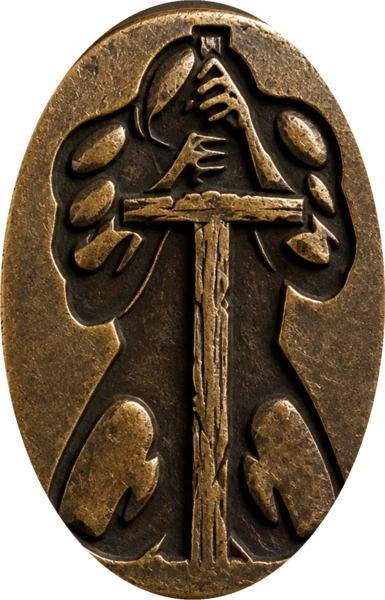
The Narrow Gate
There is a gate that cannot be widened.
Not by effort.
Not by knowledge.
Not by time.
It does not yield to sincerity, nor does it open to those who merely approach it with good intentions. Many stand near it. Few pass through.
Our Lord spoke of it plainly in the Sermon on the Mount—
a narrow gate, a hard way, and a life found only beyond it (Matthew 7:13–14).
This gate does not stand at the end of a long road of self-improvement.
It stands at the end of self.
Most who begin to consider their lives, their actions, and their patterns of sin do not begin at the gate. They begin somewhere along a path that feels, at first, like movement toward it.
There is often a progression:
A man comes to recognize sin—he sees it, names it, and no longer calls it good.
Then he begins to feel its effects—its weight, its consequences—and he does not like what it produces in his life.
Soon he sees further still—how it spills outward, wounding others, distorting relationships, leaving damage beyond himself.
This leads, in time, to frustration. He tries to correct it. He adopts disciplines, systems, voices, teachings. He searches for a way out of the cycle, yet finds himself circling back again and again.
Eventually, he comes to despise the thing itself. He hates what sin does. He hates its presence. He hates its fruit.
And yet—
he has not passed through the gate.
Because at every stage, though his understanding has sharpened, the center has remained unchanged.
It is still about what sin does to him.
What it costs him.
What it takes from him.
How it makes him feel.
How it affects his world.
Even his hatred of sin can remain self-referential.
The narrow gate is not found in the hatred of sin’s consequences.
It is found in the recognition of sin’s source.
There is a moment—quiet, often unannounced—when a man “comes to himself,” as it is written of the prodigal (Luke 15:17).
Not merely to his situation.
Not merely to his suffering.
But to his own participation in it.
He sees, not that sin has entangled him, but that he has chosen it.
Not that he is merely caught in something, but that something in him has loved what is crooked.
The shift is subtle, but absolute.
Until that moment, sin is treated as a problem to solve.
After that moment, it is seen as a condition of the heart.
And more than that—it is seen as misalignment with the One who made him.
Against You, and You only, have I sinned (Psalm 51:4).
This is the threshold.
Not apology.
Not regret.
Not even sorrow in its many forms.
But repentance.
Not merely feeling the weight of sin, but agreeing with God about it.
Not merely turning from outcomes, but turning from self-rule.
This is why the gate is narrow.
Because nothing of the self can be carried through it.
Not identity as we have constructed it.
Not the version of ourselves we are trying to improve.
Not even the one we are trying to forgive.
The gate admits only what can die and be raised.
Many are taught to think of salvation primarily as rescue—
and it is that, truly.
But if it is only understood as rescue from consequence,
then the very thing that must be left behind is often subtly preserved.
Why would one abandon the self that is being saved?
And so, without realizing it, many remain just outside the gate—
grateful, informed, sincere—
yet unchanged at the root.
They apologize.
They manage.
They adjust.
But they do not pass through.
To pass through the narrow gate is to consent to something deeper:
That the problem is not merely what I have done,
but what I am apart from Him.
That I am not simply in need of help,
but of death—and of life given back.
This is not despair.
It is clarity.
And it is here—only here—that the way becomes narrow enough to be true.
What follows in these pages are called Rules of the Road.
But they are not ladders to climb.
They are not tools to perfect the self that stands outside the gate.
They are, at best, descriptions of the way walked by those who have passed through it.
If taken up before the gate, they can become another cycle—another system, another burden, another attempt to manage what must instead be surrendered.
But if received after the gate, they become something else entirely:
Not a means of becoming,
but a way of walking.
There is, however, a mercy even here.
For it may be that, in walking these pages,
in considering these patterns,
in encountering what is described,
the Spirit of God will lead you to the gate itself.
And if that is so, then this work will have served its truest purpose.
Enter, then, carefully.
Not assuming arrival.
Not trusting familiarity.
Not mistaking understanding for passage.
For the gate is near—closer than most suppose—
and narrower than most are willing to accept.
And yet, it stands open.