OUR WAY · MATTHEW 11:29
A Way of Rest
A Way of Rest is not the end of labor. It is the end of laboring alone. It is not the abandonment of discipline, responsibility, obedience, or spiritual warfare. It is their return to proper order beneath the lordship of Jesus Christ.
MATTHEW 11:28–30
Under a Different Yoke
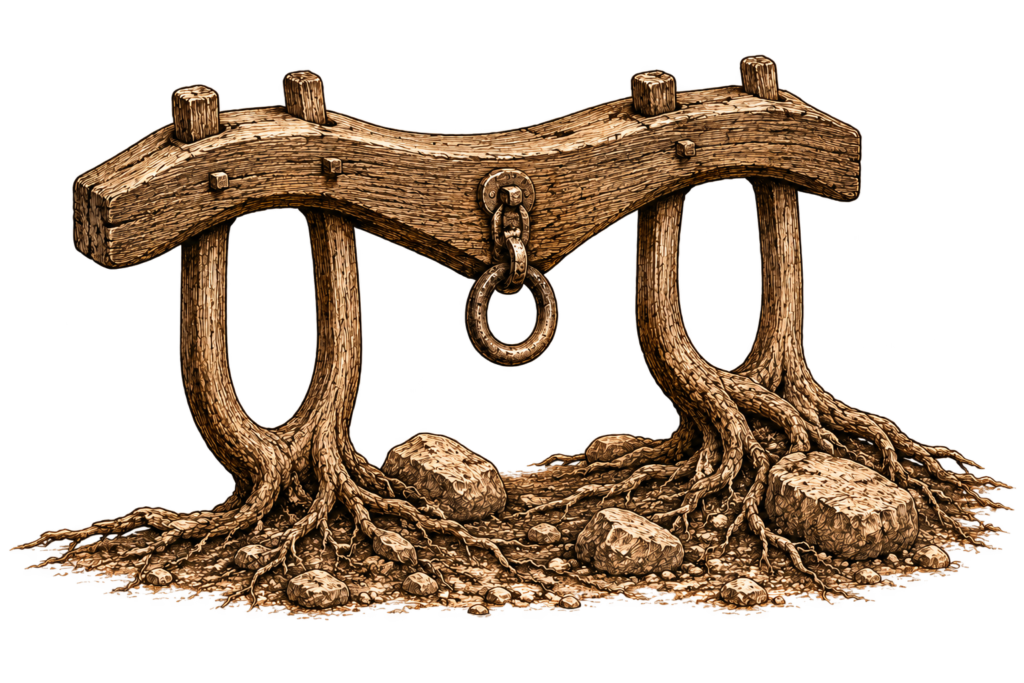
We have been told for years that the answer is to try harder. Read more. Pray longer. Wake earlier. Lift heavier. Lead better. Fix the marriage. Raise stronger children. Build the business. Serve the church. Defend the faith. Carry the burden. Never complain. Never stop. When the weight finally bends a man toward the ground, someone hands him another book, another routine, another conference, another discipline, and calls it help.
No Bible study, workout routine, leadership method, spiritual discipline, or carefully ordered life can replace communion with Jesus Christ. But this does not make those practices useless. Scripture, prayer, fasting, fellowship, baptism, the Table, confession, and service are among the places where Christ has promised to meet and form His people. “Faith comes from hearing, and hearing through the word of Christ” (Romans 10:17). The spiritual disciplines are not substitutes for the Vine; they are ways of remaining where His life may reach the branches. The danger is not discipline. The danger is using discipline to construct a righteous self who no longer needs to receive.
A Way of Rest begins when a man kneels—not because his work is unimportant, but because he is not its lord. His wife is not his possession. His children are not evidence of his success. His body, land, church, vocation, reputation, and community were not given to him so he could prove that he was strong enough to hold them together. They were entrusted to his care. He receives them as gifts without claiming ownership, and then he rises to tend them faithfully.
He repairs the fence. He apologizes to his wife. He teaches his children. He keeps his word. He serves his church. He resists temptation. He welcomes the stranger. He trains his body. He disciplines his mind. He opens Scripture when he would rather sleep. He obeys when he does not understand. He fights the good fight of faith. He does not do these things to become a son. He does them because the Father has made him one.
Paul did not say that grace ended his striving. He said, “I toil, struggling with all His energy that He powerfully works within me” (Colossians 1:29). Hebrews says, “Let us therefore strive to enter that rest” (Hebrews 4:11). The Christian life is not effortless. It is grace-powered effort. We work, but not as though the fruit depends entirely upon us. We fight, but not as abandoned men. We obey, not to purchase love, but because love has already found us.
COLOSSIANS 1:29
Receiving What Has Been Entrusted

LUKE 5:5
Obedience Takes Form

Obedience is love taking form in the body. It appears in the marriage bed, the workshop, the church pew, the dinner table, the hospital room, the field, and the difficult conversation. Sometimes obedience flows from clear sight and willing affection. At other times it comes through clenched teeth and trembling trust: “At Your word I will let down the nets” (Luke 5:5). Trust is not always ease. Often it is remaining beneath Christ’s word when nothing around us yet makes sense.
The narrow path is Jesus Christ Himself, and this way of rest is learned beneath His lordship in every part of life. We account for gravity in every step, every roof we frame, every bridge we build, and every dish we set upon a table because we know it is real. How much more should the living King—through whom all things were made and in whom all things hold together—govern the life He has given us?
We walk this path through worship, trust, obedience, and faithful attention to the next thing Christ has placed before us. It may lead where we cannot yet see, but it is held by the One who has already gone before us.
A WAY OF REST
Five Movements
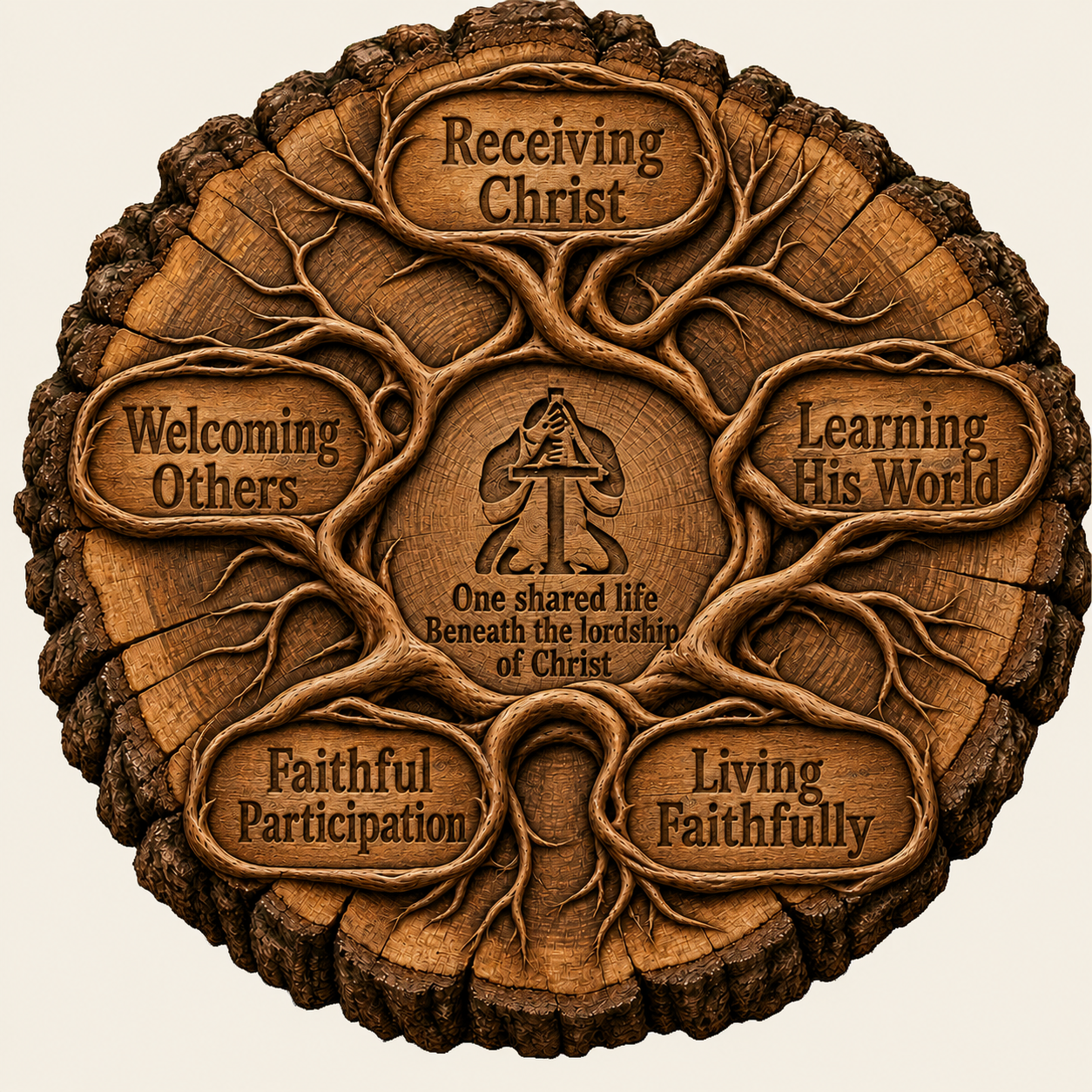
This way takes shape among us through five shared movements. They are not steps to complete or achievements to master. They describe the life we are learning to receive and practice together beneath the lordship of Christ.
Five movements • one shared posture
EPHESIANS 2:8–10
Receiving Christ
The Christian life does not begin with our strength, discipline, understanding, or usefulness. It begins with the gift of Christ Himself. Before we strive, He speaks peace. Before we bring an offering, He gives His own life. We receive His grace as needy people and His Word as truth above our own. Nothing essential begins with possession, performance, or proof. The first movement of faith is open hands.
To receive Christ is to admit that forgiveness, identity, strength, wisdom, daily bread, and the breath in our lungs come from Him. We do not work, train, build, or serve to make ourselves worthy of receiving. We do these things because Christ has already given Himself to us.
COLOSSIANS 1:15–17
Learning His World
We are learning to see creation as our Father’s good gift and Scripture as the light by which we learn to see it truthfully. The world is not meaningless matter waiting for us to impose purpose upon it, and discipleship is not an escape from embodied life. Christ meets us in kitchens, fields, workshops, friendships, worship, weather, sickness, celebration, and the ordinary responsibilities of another morning. Scripture reveals the story within which these things belong: creation spoken into being, fractured through mistrust, upheld by divine faithfulness, and being restored through Jesus Christ.
Learning His world means recovering attention. We learn to receive food with gratitude, work as stewardship, the body as entrusted life, the home as a place of formation, and creation as something to cultivate rather than consume. Nothing is merely common once it is received beneath the lordship of Christ. The world does not become sacred because we decorate it with religious language. It is already His, and we are learning to inhabit it accordingly.
COLOSSIANS 3:17
Living Faithfully
Faithfulness is not an idea that remains inside the mind. It takes shape in the way we speak, earn, eat, repair, plant, forgive, discipline, endure, celebrate, and keep our promises. Christ is Lord there too. We do not divide devotion from daily life, as though worship belongs to Sunday while the rest of the week answers to necessity, ambition, appetite, or fear. The whole of life belongs to apprenticeship under Christ.
This faithfulness is ordinary and costly. We labor seriously, love concretely, repent quickly, receive joy gratefully, and leave the fruit in the hands of God.
EPHESIANS 4:11–16
Faithful Participation
Warriors Rest is not a church or parachurch standing beside the Church. We are part of the one Body of Christ with all who belong to Him. Many among us already lead congregations and ministries. Wherever we gather, we remain members of one another, called to worship, accountability, service, submission, forgiveness, shared burdens, and the long patience required to remain with imperfect people.
Our studies, mentorship, retreats, and shared work do not replace local fellowship or draw anyone away from it. They are expressions of the shared life and labor of Christ’s Body, through which we strengthen one another for the people and responsibilities He has given us. Spiritual maturity is not measured by how quickly someone outgrows the people around him, but by how faithfully he learns to love and strengthen them. Pastors should be supported. Families should be strengthened. Gifts should be offered without demanding control. Needs should be noticed. Responsibility should be received. If we are learning the way of Christ, then the congregations, ministries, households, and communities around us should be more faithfully loved because we are present among them.
ROMANS 15:7
Welcoming Others
Because Christ has welcomed us, we learn to welcome one another. We gather around His Word and His table, carry one another’s burdens, receive the weary, and make room for those who arrive uncertain, ashamed, wounded, skeptical, or exhausted. Hospitality is not decoration or social polish. It is one way the kingdom of God takes flesh among us. A meal is prepared. A chair is pulled out. A man is allowed to speak without being hurried toward an answer. Another is carried when his strength is gone.
Widows, orphans, the weak, the defenseless, and those unable to repay us are not interruptions to the work; their care belongs near the heart of pure and undefiled religion. We remember that we walk within a great cloud of witnesses and beside the saints and martyrs whose endurance points us toward the Lamb. Together we resist evil, suffer patiently, speak truth, and strengthen one another for the road ahead. Then we send each other home with hope, courage, and a clearer sense of the good work God has placed before us.
HEBREWS 12:1–2
A People Learning to Receive
A Way of Rest is not a program that helps weary men recover enough strength to resume self-reliance. We are a people learning to receive life from Christ, lay aside what hinders, and keep our eyes fixed upon Jesus as we walk together beneath His lordship. We do not gather to dominate the world or escape it, but to inhabit the Father’s world faithfully under the reign of His Son. This shared life takes form in our households, congregations, ministries, work, and communities as together we tend what He has entrusted to us.
OUR PRAYER
Teach Us the Narrow Way of Rest
Lord, teach us the narrow way of rest. Keep us near Your Word and beneath Your lordship. Give us open hands to receive Your gifts and steady hands to tend what You have entrusted to us. Make us attentive to Your presence, quick to obey, generous in love, and faithful in the work before us.
Free us from carrying what belongs to You and from neglecting what You have placed in our care. When we do not understand, teach us to trust You. When we wander, turn us quickly back. Teach us to worship You, follow You, and gladly walk where You lead, until rest in Christ becomes the settled way of our lives. Amen.
WHERE TO GO NEXT
Walk With Us
We learn this way with others—around Scripture and the table, through prayer, honest conversation, and the ordinary work before us.